The four DISC types, explained
What D, I, S and C mean, how the DISC map places them, and how ESNC’s free DISC test matches your type to a SORA scent.
By ESNC ·
DISC is a simple way to describe how people tend to act. It sorts behaviour into four styles: D for Dominance, I for Influence, S for Steadiness and C for Compliance. Everyone uses all four. One of them usually leads, and that one is your main type.
Your type is not a box, and it is not a grade. No type is better than another. It describes your natural style: how you take on problems, how you deal with people, the pace you like and how you treat rules. Knowing it helps you understand yourself, read the people around you and meet them halfway.
Where DISC comes from
The idea goes back to the American psychologist William Moulton Marston. In his 1928 book Emotions of Normal People, he described four basic patterns in how people respond to the world around them. Others later turned his ideas into questionnaires. Today DISC is used by many workplaces, schools and teams.
DISC describes behaviour. It is not a medical or clinical test, and it says nothing about how smart or capable you are.
The DISC map
Two questions place the four types on a map.
- Are you more active and outgoing, or more reserved? Active types speak up early and set the pace. Reserved types watch and think first, then act.
- Do you lean toward tasks or toward people? Task-oriented types think first about the work, the facts and the result. People-oriented types think first about the people and how they feel.
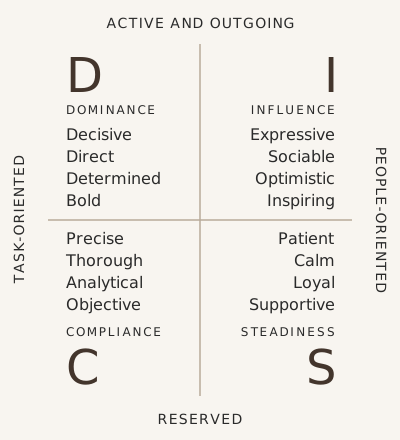
- D sits top left: active and task-oriented.
- I sits top right: active and people-oriented.
- S sits bottom right: reserved and people-oriented.
- C sits bottom left: reserved and task-oriented.
Neighbours on the map share one side. D and I are both active, so both like to move fast. S and C are both reserved, so both like time to think. D and C both put the task first, so both like a clear plan. I and S both put people first, so both care how everyone feels. Types in opposite corners, D and S or I and C, differ on both questions. That is often where misunderstandings start, and where two people can learn the most from each other.
D · Dominance: you move things forward
What it describes: how you take on problems and challenges.
A high D acts fast, takes charge and wants results. A low D weighs the options, works things out with others and avoids open conflict.
At your best: you decide when others hesitate, you see the shortest path to the goal, and you get things started.
In real life: plans change at the last minute and the group stalls. You are the one who says “Here’s the new plan” before anyone has finished complaining.
Watch out for: under pressure, a D can push harder and talk over people. To grow: hear other views before you decide, and notice people’s effort, not only their results.
I · Influence: you bring people with you
What it describes: how you connect with people and win them over.
A high I is expressive, optimistic and quick to trust. A low I is quieter, more thoughtful and careful with trust.
At your best: you lift the mood in a room, you make new people feel welcome, and you get others excited about an idea.
In real life: at a party full of strangers, you end up talking to almost everyone. By the end of the night, two of them have swapped numbers because you introduced them.
Watch out for: when someone doubts your word, an I can argue back hard, or promise more than fits in one week. To grow: listen to the end before you answer, finish what you start, and check the facts behind a good idea.
S · Steadiness: you keep things steady
What it describes: your pace, and how much you need things to stay stable.
A high S is patient, consistent and likes a steady rhythm. A low S changes quickly, gets restless and enjoys variety.
At your best: you listen well, you stay loyal for the long run, and you calm a tense moment.
In real life: a friend calls late at night, upset. You don’t rush to fix anything. You listen for as long as they need, and they hang up feeling lighter.
Watch out for: under pressure, an S may go quiet and say “it’s fine” when it isn’t. To grow: say what you need early, take on change in small steps, and share tasks instead of carrying them all.
C · Compliance: you get it right
What it describes: how you deal with rules, standards and information.
A high C is careful, precise and trusts a clear process. A low C is independent, flexible and willing to take risks.
At your best: you see details others miss, you ask the right questions, and you plan carefully.
In real life: before buying a new phone, you compare three models line by line, read the reviews and know each battery size by heart. You rarely regret what you buy.
Watch out for: under pressure, a C can keep digging for more data and resist change. To grow: act before everything is certain, accept small mistakes, and share feelings, not only facts.
Your main type and your second side
Most people lead with one type and have a clear second one. ESNC names every result as a pair, main type first, for example D·I or S·C. Your main type is the style you use most. Your second type is your other side, the one that shows up when a moment calls for it.
An I·S, for example, lights up a room and makes people feel at home. An I·C shares ideas with flair, backed by care for detail. Same main type, two different people.
How ESNC uses the DISC test
ESNC’s free DISC test was written for ESNC, in English or Bahasa Indonesia. Each question is a group of four words or short phrases, one for each type. You pick the one most like you and the one least like you.
- The quick test uses 10 groups and takes about 3 minutes. It finds your main type and the scent that matches it.
- The full test uses all 28 groups and takes about 10 minutes. It gives a more accurate pair, your second side and three graphs of your scores.
Your score for each type is simple: how often you picked it as most like you, minus how often you picked it as least like you. The highest score is your main type. After the last group, you enter your email and see your result straight away. Both tests show your whole profile, and a copy of your report goes to your inbox.
Each type has its own scent: SORA HER and SORA HIS, Type D, I, S and C. SORA perfumes are crafted with perfumers from France and England. Your main type sets your scent, and your second type is your other side. ESNC Society is a community for people who want to understand themselves and grow with others. Spend IDR 300,000 on ESNC products, in one order or several, and you’re a member for 12 months.
FAQ
Is one DISC type better than another?
No. Each type has its own strengths and its own blind spots. Teams, friendships and couples work best when people know their styles and adjust a little to each other.
Can my DISC type change?
Your style can shift over time, with a new job, a new city or a new stage of life. That’s why you can take ESNC’s test again whenever you like.
How long does the ESNC DISC test take?
About 3 minutes for the quick test (10 groups) and about 10 minutes for the full test (28 groups). Both are free.
What is the difference between the quick and the full test?
The quick test finds your main type and your scent. The full test uses every group, so its pair is more accurate. It also adds your second side and three graphs: most like you, least like you, and your blend.
Is DISC the same as MBTI?
No, they are different models. MBTI sorts personality preferences into 16 types. DISC looks at four styles of behaviour, which makes it quick to learn and easy to use with the people around you.
Which SORA scent matches my type?
Each DISC type has its own pair of scents: SORA HER and SORA HIS, Type D, I, S or C. Take the test to find yours.